
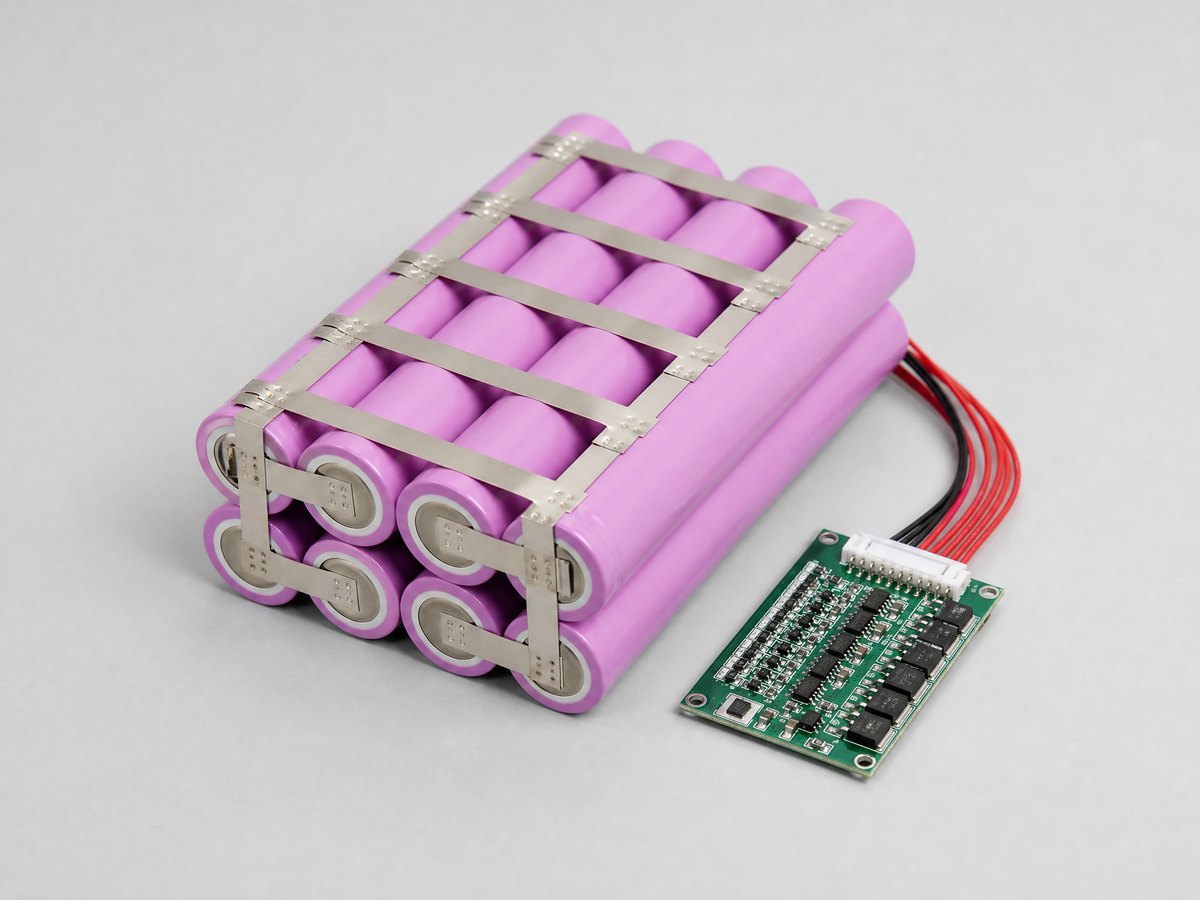
Short Answer
Neither format is automatically better — the finished pack decides. An 18650 cell measures 18 × 65 mm and typically stores 2.5–3.5 Ah, while a 21700 cell measures 21 × 70 mm and typically stores 4.0–5.0 Ah. Because each 21700 holds more energy, a 21700 pack can reach a target capacity with fewer cells in parallel, which usually means fewer welds, fewer interconnect points and lower internal resistance — but it also makes the pack physically bulkier. Range still comes from the pack's watt-hours (Wh = Volts × Ah) and your bike's Wh-per-mile consumption, not from the cell format itself. Choose 18650 for compact frames and slim packs; choose 21700 for high-capacity or high-current builds where the case has room.
The Two Formats in One Table
The numbers in the names are simply dimensions in millimetres: 18650 = 18 mm wide, 65 mm long; 21700 = 21 mm wide, 70 mm long.
| Specification | 18650 | 21700 | What it means for your bike |
|---|---|---|---|
| Diameter × length | 18 × 65 mm | 21 × 70 mm | A 21700 needs a taller, wider case |
| Typical cell capacity | About 2.5–3.5 Ah | About 4.0–5.0 Ah | Fewer cells needed for the same Ah |
| Typical single-cell weight | About 45–48 g | About 60–72 g | Pack weight depends on the whole build, not one cell |
| Parallel cells for 48V 20Ah | Higher count (more cells in parallel) | Lower count | Fewer welds and interconnects with 21700 |
| Current handling | Model dependent | Many high-current models | Check the datasheet, not the format |
| Heat under load | Model dependent | Often lower internal resistance | Depends on load, layout and BMS limit |
Cell-format reference values: comparison published by the EM3ev technical team (updated August 2026) and standard vendor part numbering. Cell-level figures vary by model — always check the exact datasheet.
Why 21700 Became the Default for Modern E-Bike Packs
Two practical reasons:
- More energy per cell. A 4.8–5.0 Ah 21700 replaces roughly one and a half 3.2 Ah 18650 cells.
- Fewer connections for the same watt-hours. A 48V 20Ah pack (960Wh) built with 21700 cells needs fewer parallel groups than the same pack built with 18650 cells. Fewer cells in parallel means fewer spot welds, less nickel strip and shorter current paths.
That is why our own 21700 platforms exist: the SYR Kingkong JD-012SR integrated pack and the 48V 30Ah pack built on Samsung 21700 50S cells (13S6P) are both 21700 designs. The 13S6P layout is worth reading closely: 13 cells in series for 48V, 6 in parallel for capacity and current — the "6P" number is smaller than it would be with 18650 cells, which is the whole point of the format.
What Cell Format Does Not Change
This is where most buying mistakes happen. Cell format does not change:
- Your range, by itself. Range is usable watt-hours divided by energy consumption per mile (usually 20–30 Wh per mile on an e-bike). A 48V 20Ah pack is 960Wh whether the cells inside are 18650 or 21700 — see our guide to amp hours and range for the full calculation.
- Your voltage. Voltage comes from the number of cells in series (13S ≈ 48V, 10S ≈ 36V, 14S ≈ 52V), not from cell size. Our 36V vs 48V vs 52V comparison covers that choice.
- Charger compatibility. A charger matches the pack's chemistry, full-charge voltage, connector, polarity and permitted charge current. Do not assume a charger is right because the plug fits.
- Safety. No lithium pack is risk-free. Safety comes from quality cells, correct fusing, insulation, mechanical protection and a matched BMS — not from the format.
When 18650 Is the Better Choice
- Compact frames and slim cases. A down-tube case that is 18 mm-limited internally cannot take 21 mm cells. If the bike was designed around a slim 18650 pack, an 18650 replacement keeps the original footprint.
- Lower upfront cost at moderate capacity. For a 10–14Ah commuter pack, 18650 cells remain economical and widely available.
- Proven, well-documented designs. Many original-equipment packs on commuter and folding bikes are 18650-based.
Real examples from our own catalogue:
| Pack | Cell format | Typical use |
|---|---|---|
| 36V/48V 14Ah / 17.5Ah down-tube pack | 18650 | 250W–1000W conversion kits |
| 48V 10.5Ah folding pack for Jetson Haze HA318 | 18650 | Folding bikes, slim internal case |
| 36V 15.3Ah pack for Segway Ninebot MAX G30P/G30LP/G30D | 18650 | Kick-scooter, communication protocol |
| Rear-rack pack, 20Ah / 30Ah / 35Ah | 18650 (Grade A) | High capacity in a rack-mounted case |
When 21700 Is the Better Choice
- High-capacity packs in the same case. Fewer, larger cells can pack more watt-hours into a well-designed downtube or triangle case.
- High-current builds. Many 21700 models are engineered for sustained discharge, which suits 1000W–2000W controllers and steep climbs where voltage sag hurts.
- Long-range and cargo use. Where each watt-hour counts and the frame has room.
Examples from our catalogue:
| Pack | Cell format | Typical use |
|---|---|---|
| 48V 30Ah pack, Samsung 21700 50S (13S6P) | 21700 | 100A continuous / 150A max discharge |
| 60V 40Ah triangle pack, Samsung 50S | 21700 | 3000W–5000W builds, 100A/150A BMS |
| 36V/48V/52V 20Ah pack, 40A BMS | 21700 | Bafang / hub-motor conversions, 0–1500W |
| Reention Dorado replacement, 48V–72V 15/20Ah | 21700 (Grade A) | Dorado-case bikes, removable |
How to Tell What Is Actually Inside a Pack
Listings often advertise a cell brand without evidence. Three sanity checks before you buy:
- Do the watt-hour maths. Ah × V = Wh. If a pack claims 48V 25Ah, that is 1,200Wh — compare that figure against the physical case size and the weight. A very high capacity in a very small, very light case is a red flag.
- Ask for the series/parallel layout. A serious supplier states it (for example "13S6P"). The layout tells you both the voltage and the current capability.
- Match the pack's continuous current to your controller. A pack that cannot sustain your controller's draw will sag, heat up and age faster. Our BMS guide explains what to look for in the protection board, and our fire-safety checklist covers the rest.
Heat, Voltage Sag and Pack Life
Under load, two things decide whether a pack feels strong or tired: internal resistance and current per cell.
- Voltage sag is the temporary voltage drop you see when you open the throttle. Higher internal resistance means more sag, less available power and more heat.
- Current per cell matters because the load is shared across each parallel group. If a pack uses fewer, larger cells, each cell carries a larger share — which is exactly why high-current builds use cells rated for sustained discharge, not just high capacity.
- Heat is the real enemy of cycle life. Cells that run hot age faster. A pack that is comfortably within its continuous rating runs cooler than one pushed to its limit.
| Symptom you feel | Likely cause | What to check |
|---|---|---|
| Big voltage drop on hills | High internal resistance or too few parallel cells | Pack's continuous current rating vs controller draw |
| Pack gets noticeably warm | Sustained over-current | Cell datasheet, BMS limit, conductor sizing |
| Range fell faster than expected | Aged cells, partial charging habits, cold weather | Cell condition, charge practice, storage temperature |
| Cuts out under acceleration | BMS current limit reached | BMS rating vs controller peak current |
A larger cell format is not a cure for any of these on its own. What fixes them is a pack whose cells, BMS, wiring and case are specified together for your controller and riding profile. If you are unsure what your controller draws, our beginner's conversion battery guide walks through matching a pack to a kit, and our buying guide covers the rest of the checklist.
What About Weight and Cost?
Cell format changes both, but not in the direction people expect.
- Weight per cell: a 21700 is heavier (roughly 60–72 g versus 45–48 g). However, when you reach the same capacity with fewer cells, the difference partly cancels out. Compare the finished pack weight at equal watt-hours.
- Weight per watt-hour: modern high-capacity 21700 cells generally offer more watt-hours per kilogram at the cell level, but pack weight also includes the case, BMS, conductors, potting and hardware — which often dominate on smaller packs.
- Cost: 18650 cells remain cheaper per unit and are available in enormous volume, which keeps small commuter packs economical. 21700 packs cost more per cell but may use fewer cells and less labour in welding and interconnects. For a 10–14Ah pack the 18650 route is usually the value choice; above that, the maths starts to favour 21700.
Practical Takeaways
- 18650 = 18 × 65 mm, typically 2.5–3.5 Ah per cell; the compact, economical option.
- 21700 = 21 × 70 mm, typically 4.0–5.0 Ah per cell; fewer parallel cells per pack.
- Range tracks watt-hours, not cell format: a 960Wh pack is a 960Wh pack.
- Fit first: if the case or frame is size-limited, the format decision is already made for you.
- Current second: match the pack's verified continuous rating to your controller.
- Ask for the series/parallel layout and the cell datasheet — then compare packs fairly.
FAQ
Is 21700 better than 18650 for e-bikes?
Not automatically. 21700 cells usually offer more capacity per cell, which lets a designer use fewer parallel cells for the same watt-hours. Whether that is better depends on your case dimensions, controller current, budget and the exact cell models used.
Does a 21700 battery give more range?
Only if it stores more watt-hours. Range = usable Wh ÷ consumption per mile. A 48V 20Ah 18650 pack and a 48V 20Ah 21700 pack both deliver 960Wh and therefore similar range, assuming comparable cell quality and pack build.
Are 21700 packs heavier?
A single 21700 cell is heavier than a single 18650 cell (roughly 60–72 g versus 45–48 g), but a pack often uses fewer of them for the same capacity. Compare the published weight of complete packs at similar watt-hours instead of comparing cell weights.
Can I keep my charger if I switch cell format?
Yes, provided the pack's chemistry, full-charge voltage, connector, polarity and permitted charge current match the charger. Cell format itself is not the deciding factor — always use the charger specified for the exact pack.
Can I rebuild my 18650 pack with 21700 cells?
Only if the case physically fits the larger cells and the BMS, wiring, fusing and insulation are re-specified for the new layout. Rebuilding lithium packs requires proper training, equipment and hazard controls; if you are unsure, buy a completed pack built for your bike instead.
Need Help Choosing the Right Pack Format?
Tell us your bike model, the existing battery's voltage and capacity, the controller current and the case dimensions — we will confirm which format fits and quote the matching pack.
- Browse 48V e-bike batteries and 52V packs
- Or contact our team with your battery label photo and case measurements